

“Re-engaging Students, Re-invigorating Staff, Re-shaping Culture”
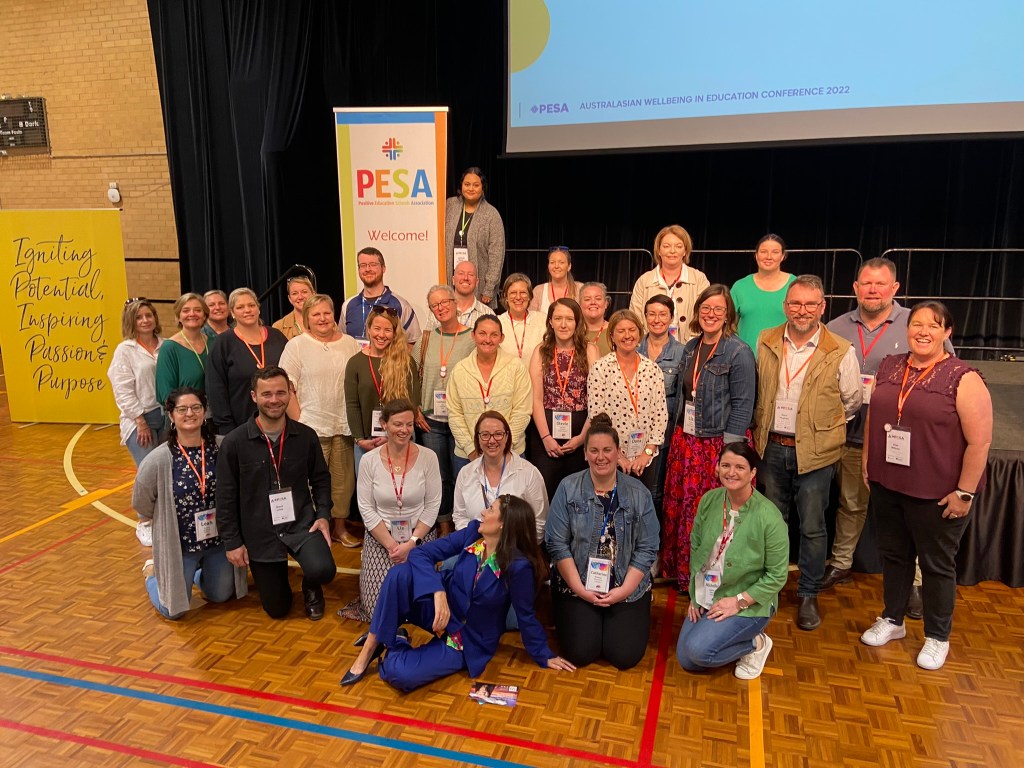
Positive Education Schools Association (PESA) – 2022 Australasian Wellbeing in Education Conference, hosted by Ravenswood School for Girls, Sydney on 6 – 8 October 2022.
I’d like to begin by thanking the Where there’s a Will foundation for sponsoring the attendance of 41 Upper Hunter delegates at the recent PESA conference. It was an inspiring and invigorating conference, action-packed with a full program of incredible keynotes and workshops. There was so much to take away and consider for our context at Richard Gill School, and I look forward to crystalising my thoughts and sharing these with our community as we begin to plan the next steps for wellbeing at RGS. Due to the overwhelming breadth of presenters, I’ve narrowed my comments down to those that resonated most clearly with me and our context.
So, what is Positive Education?
Positive education is the combination of traditional education principles with the study of happiness and wellbeing.
The fundamental goal of positive education is to promote flourishing or positive mental health within the school community.
(Norrish, Williams, O’Connor, & Robinson, 2013).
A school curriculum that incorporates wellbeing will ideally prevent depression, increase life satisfaction, encourage social responsibility, promote creativity, foster learning, and even enhance academic achievement.
(Waters, 2014).
Day 1 of 3 – Learn It, Live It, Teach It.
After navigating the always anxiety-inducing travel and parking arrangements of the big smoke, I arrived at the conference early and ready to absorb. Thankfully, day 1 was a shorter day than 2 and 3.
The conference was officially opened by the enigmatic Principal of Ravenswood, Anne Johnstone, who handed over to Rachel Colla who commenced proceedings. Rachel discussed the innate desire in everyone to achieve peace and prosperity, to have hope, and reminded everyone that wellbeing is woven throughout the UNESCO strategy on Education for Health and Wellbeing, setting a wonderful platform for the remainder of the conference. The question was asked, what should we cultivate in our existing environment? (Not what should we change, but what should we grow) The wording of the question was intentionally strengths based, as was a key focus of the conference.
Jenni Cooke introduced the mantra which will stick with me
learn it, live it, teach it.
Jenni Cooke
Not only is this a great mantra for implementing wellbeing practices, but for implementing any new initiative in a school (or any context for that matter). This inspired me to build into our Term 4 staff meetings the opportunity to discuss in greater detail each of the 24 VIA character strengths, before we move forward with the full implementation of our wellbeing program. Staff training was identified as the biggest challenge throughout the conference, and the importance of “building it into the fabric of our school/DNA” was emphasised from Jenni’s lived experience at Mount Barker High School.
Day 2 of 3 – Resilience and Relationships
After an enjoyable evening connecting with the Upper Hunter educators and Professor Lea Waters AM, day 2 was kicked off by Professor Jane Gilham who discussed “Bringing out their best; promoting students’ resilience and strength”. She identified that the strongest predictor of resilience in children is having positive, supportive, and caring relationships, predominantly with parents and immediate family members. This statement is reinforced by decades of research. Also discussed was the concept of “savouring”, “gratitude”, and ultimately “celebrating the wins”. The engaging David Bott then introduced a fun brain-break game, “To Clap or not to Clap”, which I will definitely be teaching students and staff next time I see them!
Next, we heard from Professor Barbara Fredrickson, who reinforced the importance of the frequency of positive interactions, versus their intensity. Throughout the course, we were also reminded that for a person to have a positive experience and build a positive relationship, they need an average of 5 positive interactions versus 1 negative interaction. This is critical to consider when dealing with children who present with challenging behaviours, particularly if your role in a school is to support staff with behaviour management and subsequently work with parents and carers who require the same ratio of positive to negative contact.
Dr Stephen Kennaugh then spoke about the need to combine learning and wellbeing frameworks, and that they cannot successfully function in isolation. This sentiment was echoed throughout the conference.
Prior to lunch, we had our first opportunity to attend a breakout session where delegates could choose from a list of presenters. I opted to attend a session by Dana Kerford, “A whole school friendship strategy”, which sounded extremely age appropriate for our K-2 children at RGS. This session was one of my favourites from the conference, and I left the session feeling excited to share the program with my staff.
Some highlights were:
- You can’t change what you can’t acknowledge;
- Without strategies for friendships/relationships we revert to default of fight, flight, freeze and fawn;
- Relationships are the heart of wellbeing and learning (talking my language!);
- Connection before content;
- Ask and pass;
- “Friendship fires” are NOT bullying;
- Circles (closed, negative) vs horseshoes (open, welcoming) when conversing in groups (adults are guilty of this too!);
- Be a fire fighter not a fire lighter
- One needs to have a quick comeback to combat “mean on purpose” behaviour.
Overall, the program looks amazing and has been successful in many schools, perhaps it might work at RGS too? Check out URSTRONG for more info. Parents can sign up for free and access resources.
After lunch we heard from possibly the most engaging presenter of the conference, Dr Justin Coulson, parenting expert and TV celebrity. Dr Coulson discussed self-determination theory, and that we must believe that all people (i.e., staff, students, parents) have the innate desire to learn and grow and master their environment. The theory states there are 3 universal and innate psychological needs:
- Competence, where low competence equals low motivation,
- Relatedness, must feel connected to those around them,
- Autonomy, must have a sense of choice and volition.
There was more, but Dr Coulson was so engaging I may not have written down everything I’d liked to! Do yourself a favour and follow “Dr Justin Coulson’s Happy Families” on Facebook here – the page is very active and a wonderful resource for all parents and those in child related work.
The remaining afternoon sessions involved a final keynote, followed by a rapid fire 10 x 5minute “spark sessions – ideas to spark action”. Of note was a session by Julia Delaney from Grow Your Mind, who reminded us to have generous assumptions, i.e., always assume the best in people (we naturally have a negative default). A strategy for discussing an issue with people is to start the conversation with “the story I’m telling myself is…”.
My final mantras and messages for the day that stuck with me were
“taught, caught, sought”
“glow, grow, go”
“nothing about us, without us”
“learn it, live it, teach it!”
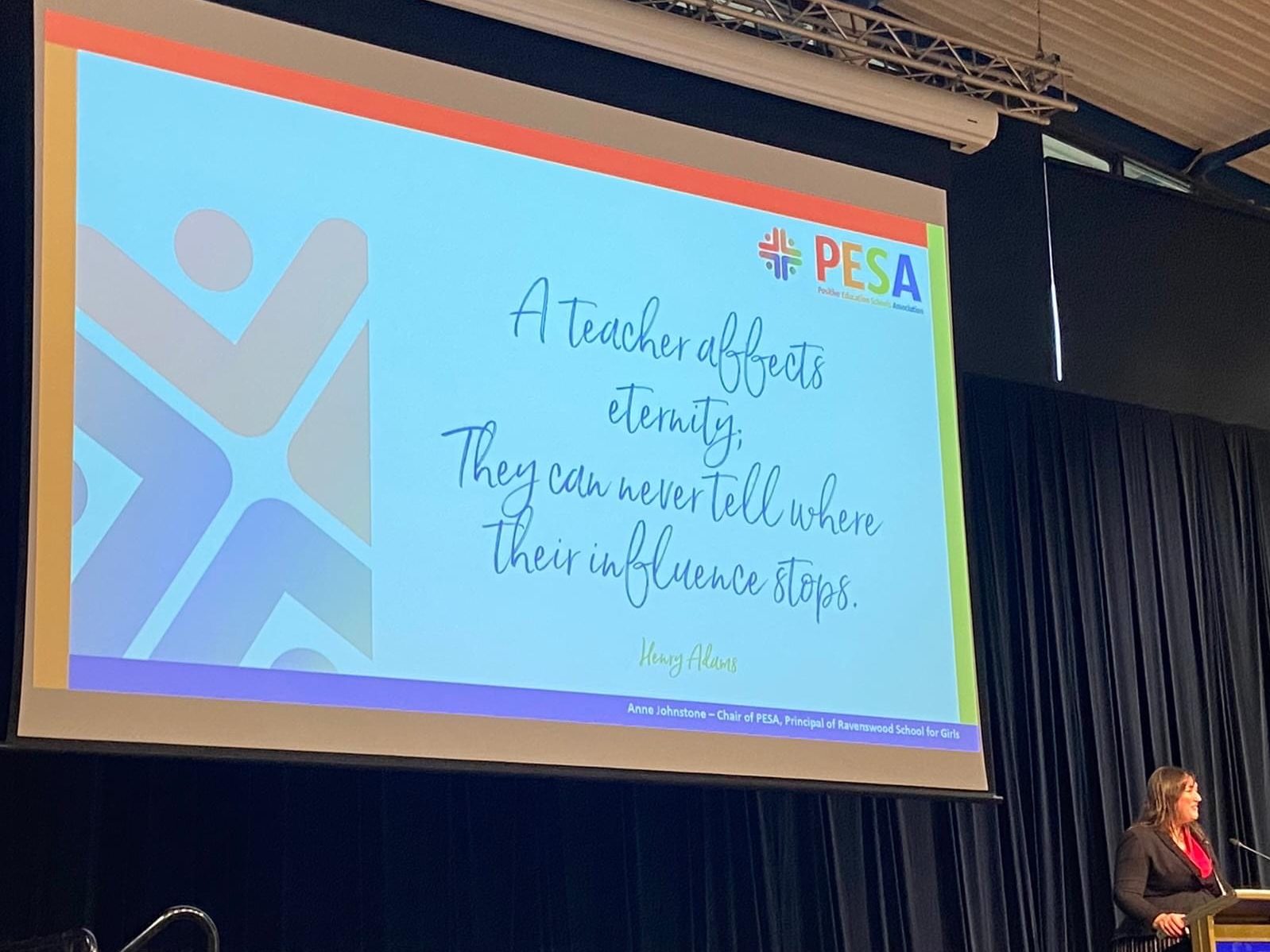
Day 3 of 3 – Growing Through Adversity + The Technology Trap
After another great night of socialising, this time with all delegates at Luna Park, I pushed through for an early start, running to Artarmon reserve for a 6:30am start to volunteer at Parkrun, before completing the course myself. A tidy 10kms to start the day focussing on my own wellbeing (a fraction of what Nedd Brockmann recently put himself through for 47 consecutive days!).
Professor Lea Waters AM had the pleasure of opening day 3 with the self-described “graveyard shift”, however, the organisers couldn’t have selected a better presenter to wake everyone up, and this was easily the pick of the sessions. Professor Waters is responsible for starting her “Visible Wellbeing” framework, and her keynote was titled “Growing through adversity”, the concept of adversarial growth, which is of huge interest to me.
I’m sure we can all immediately think of people in our lives who have demonstrated either a positive or negative response to adversity in their life, and Lea spoke candidly about her own adversity which was deeply moving and inspiring to consider her response. I won’t go into the details but would encourage everyone to take the opportunity to see Lea talk or read her book, The Strength Switch, if this field of positive psychology interests you.
Trauma doesn’t have to break you, it can make you.
Prof Lee Waters AM
Dr Kristy Goodwin was next up with her keynote “Connected but disconnected, helping students to thrive in the digital world”. This session was immensely important for me. Having spent 12 years working in high school before shifting to primary, and experiencing addiction to technology myself, I took a lot from Dr Goodwin’s session, as I have strong feelings about the use of technology with young people.
Dr Goodwin begun by asking us to inspect the pinkie finger of our dominant hand where we cradle our phone, highlighting that the human body is beginning to make physical adaptions for our overuse of technology, scary stuff! There are also new terms being created such as monophobia, fear of not having a phone, and phantom vibration syndrome.
Black Dog Institute have reported that mental health issues have doubled in the last 14 years. We need to connect, belong, and have strong relationships, not just through a screen. The 3 C’s that we need are:
- Connect
- Competence
- Control
Use of technology and social media is designed for a dopamine hit, with overrides our ability to self-regulate. The reason our notification bubble is red is that this suggests to the brain danger and urgency, which is why we never feel satisfied and can scroll endlessly without feeling finished. FQ – ability to focus; Dr Goodwin claims this will be the “super skill of the 21st century”. Unfortunately, children with unrestricted access to technology will sacrifice their own biological needs (relationships, sleep, nutrition etc) over the desire to continue accessing technology.
Overall, I would consider use of technology the greatest threat to wellbeing and learning today. This is why, whilst we have technology at RGS and in my own home, and certainly meet the necessary educational outcomes for using technology, I always stress to our staff and parents upon enrolment that we limit the amount of technology we use at school.
Dr Goodwin recommends watching the documentary, Social Dilemma, and reading her book, The State of Student Wellbeing
For me, this was almost the end of the conference. Professor Joseph Ciarrochi was fabulous, funny, but unfortunately missed the mark a little with an extremely academic focus. Melissa Searle and Karen Wood were great, real world school leaders, who have transformed a school in a low socioeconomic area through their rigorous use of wellbeing strategies. Kate Wilkie and Kasey Lloyd from the Positivity Institute presented a post-strengths framework which felt very upper primary/secondary focused, and a little too far out of reach for us at this stage but were still highly engaging and informative.
My final session of the conference was a 30 minute “taster session” with Professor Lea Waters AM, “Making wellbeing visible in schools”.
RGS has begun working with the visible wellbeing and character strengths frameworks developed by Professor Waters, and this session provided further insight into the reasons why it has been adopted and so strongly supported by Pauline Carrigan and the Where There’s a Will foundation. The session began with a funny brain break called “bok” (think of the noise a chicken makes). In the short session, Professor Waters reminded us that visible wellbeing is a “suite of practices”, not a scope and sequence or an explicit curriculum. It does not need to be timetabled but builds a culture of wellbeing across a school.
The SEARCH framework was determined upon reviewing 18403 peer-reviewed articles from more than 700 journals; Strengths, Emotional Management, Attention & Awareness, Relationships, Coping, and Habits & Goals.

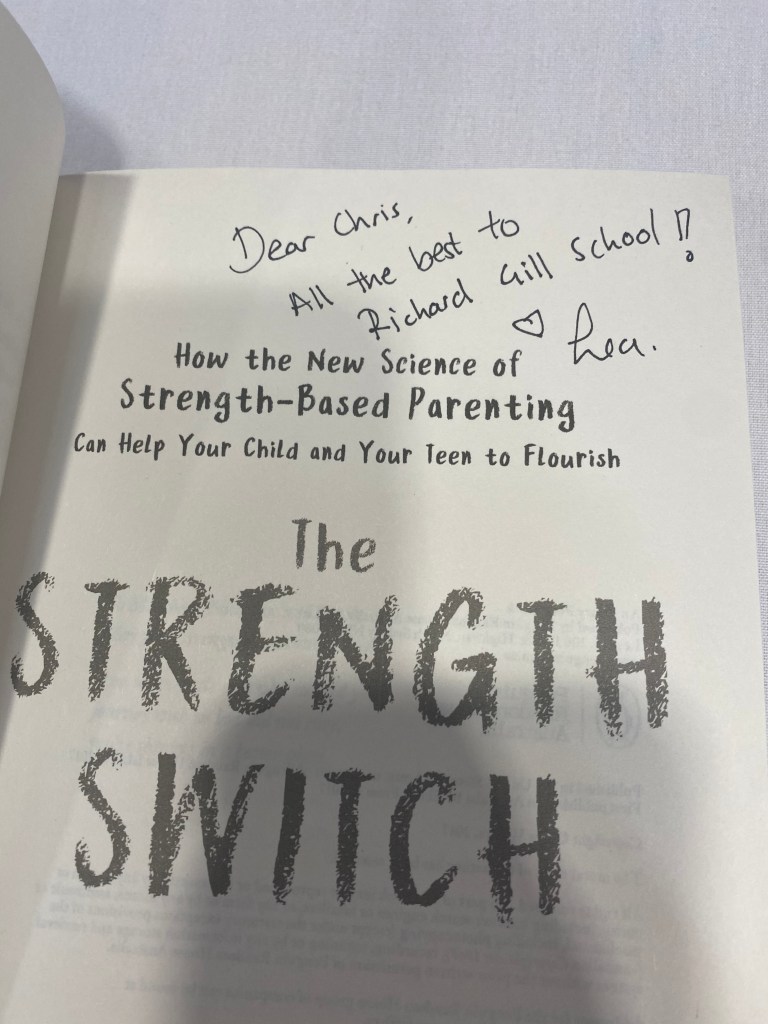
I was thrilled to purchase Professor Waters book, “The Strength Switch”, and would recommend this to all parents and those who work with children. I am about halfway through at the moment.
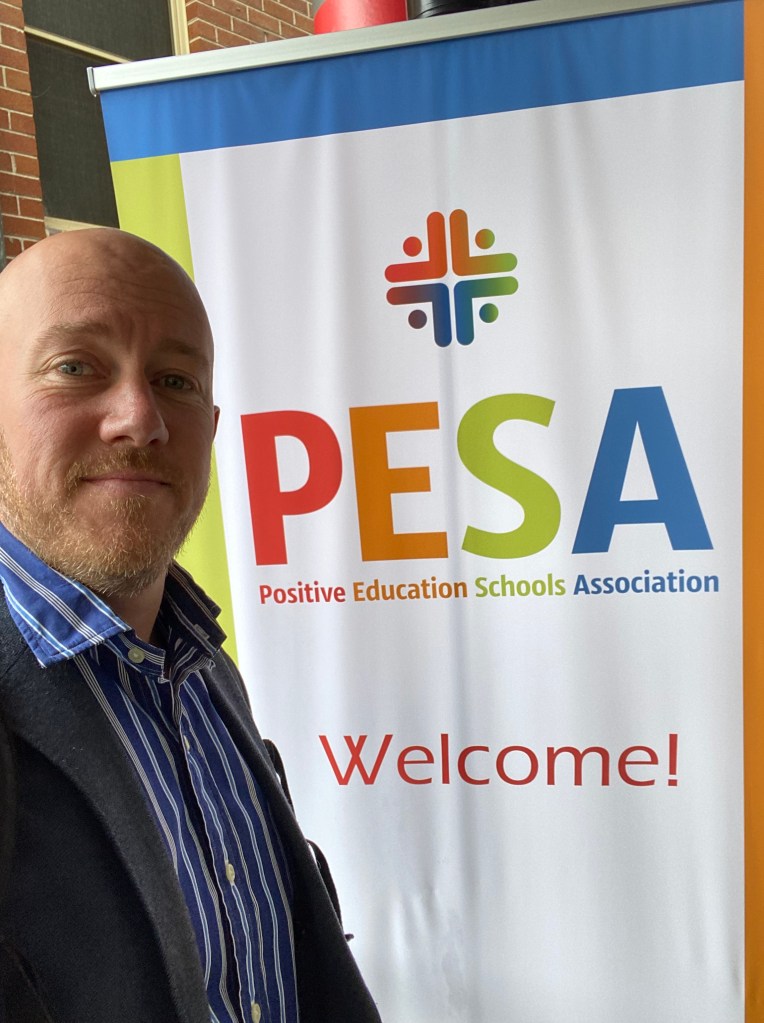
To summarise, the PESA conference was an outstanding professional learning opportunity which I am grateful to have been able to attend, sponsored by Where there’s a Will. It is exciting to have a blank canvas at RGS to create a school that embraces positive education and focuses on wellbeing. Having been in numerous wellbeing leadership roles prior to my principalship, this is a natural progression for our school and one which I believe will be well received. Music and wellbeing are intrinsically linked, and I hope that in the years to come we will see our students continue to flourish through our musical and strengths-based approach to education.
Chris English
Principal and Educator
References:
https://positivepsychology.com/what-is-positive-education/
https://en.unesco.org/themes/education-health-and-well-being
https://www.leawaters.com/vwb-search-for-wellbeing-course

 Chris English