
I recently heard a Simon Sinek quote which went along the lines of, “wellbeing improves in the workplace when leaders recognise they are not responsible for the outcomes of the workplace, rather they’re responsible for the PEOPLE who are responsible for the outcomes.”
I’ve always been passionate about the importance of wellbeing in schools, for both students and staff. I believe that for everyone in a school to do their best and be the best version of themselves, they need to have high levels of wellbeing. For students, this enables them to be curious and engaged learners. For staff, this enables them to provide the highest level of support to students and be collaborative members of the workforce. People with high levels of wellbeing are more resilient, more motivated, and more likely to seek opportunities for growth. The evidence of these benefits is well documented. For instance, research shows that teachers’ wellbeing significantly impacts student outcomes and stress levels (Oberle & Schonert-Reichl, 2016), and a quick Google or scholarly article search will find many more sources.
Now back to this quote from Simon Sinek, who is without a doubt one of the leading international voices in business and leadership. Personally, I found the quote challenging to digest as it can be interpreted in several different ways. One way is contrary to what I’ve been led to believe in my recent leadership experiences. As leaders, we’ve all heard the phrases such as “the buck stops with you” and in the school context, “the principal is responsible for the performance of the school and student outcomes”. That is, the leader of an organisation is always responsible for the outcomes achieved by the organisation, be them good, or bad. Is Sinek removing the burden of responsibility from leaders in this quote? Is he suggesting that leaders are NOT responsible for the outcomes of an organisation, as he says in the first part of his quote?
We know that to affect change we must focus on things within our control, or our circle of influence (Covey, 1989). I believe that what Sinek’s quote serves to highlight is that school and student outcomes will improve MORE if leaders focus LESS on what is outside of their direct control, i.e. improving student outcomes at a micro level, and instead focus on leading their team well and looking after the PEOPLE at a macro level, which is within their circle of influence and will have the same desired outcomes on the organisation (probably better) if done well.
The simplicity of this Sinek quote is probably what I find most intriguing. As a leader, particularly of a smaller organisation, it can be tempting to dive into finding solutions for poor outcomes when, as Sinek suggests, the emphasis should be placed on working with middle leadership or frontline staff to improve their performance. I’ve been guilty of this temptation myself at times and have also witnessed this play out in numerous schools I’ve been a part of, and I’ll admit the result is leadership feeling overwhelmed with the breadth of work required, and still not achieving what they’d set out to achieve. Clear processes and hierarchy of control can help manage this challenge, but we must remember that people are complex, and schools are full of people of all ages, backgrounds, and life experiences interacting with one another on a daily basis – a true melting pot where you never know what each new day will bring!
What Works
So, what works when it comes to wellbeing in the workplace?
This is not a new area for thought leaders in education and leadership, which means there is ample research and resources to consider.
From my own observations and experiences as a leader, the following practical activities have shown to be highly effective in enhancing the wellbeing of staff in schools, and can be easily adopted by most workplaces:
- Staff acknowledgement at meetings or newsletters / other relevant staff communications: This shows that staff contributions are valued (Umlas, 2017).
- Food: Bringing people together with food fosters social bonds. Most people love a full belly and the relief of not having to pack or buy lunch (Dunbar, 2017).
- Physical activities: Gentle team or individual sports like volleyball, soccer, walking, tennis, suitable for your context, is a great way to help encourage staff to be active and practice the benefits of exercise on mental health and wellbeing, whilst also fostering social bonding and teamwork (Biddle & Asare, 2011).
- Social activities: Social catch up’s, debriefs, race days, and other social events and activities undertaken as a team can help build comradery and improve wellbeing.
Healthy Work Culture
Most importantly and in addition to the list above, I would like to highlight the importance of “healthy work culture”. This is a multifaceted concept which requires strong leadership with effective processes and procedures implemented across the workplace. A healthy workplace cultureis critical for the achievement of high staff wellbeing. Below are some key items I personally believe are crucial when fostering a healthy work culture, with staff often highlighting to me that these items positively impact their wellbeing when done well:
- Clear communication: Clear communication is linked to higher employee satisfaction and productivity (Clampitt & Downs, 1993).
- Clear roles and responsibilities: Hierarchy and a good understanding of who does what.
- Opportunities for collaboration: Staff working on tasks solo can become overwhelmed, resentful, or lose sight of best practice if working in isolation for too long.
- Opportunities for professional development: Continuous professional development for staff is crucial for maintaining high levels of performance and job satisfaction (Guskey, 2002)
- Strong sense of purpose: Moral purpose is well documented in educational leadership as being highly important for wellbeing.
Real World Example – Gidgees
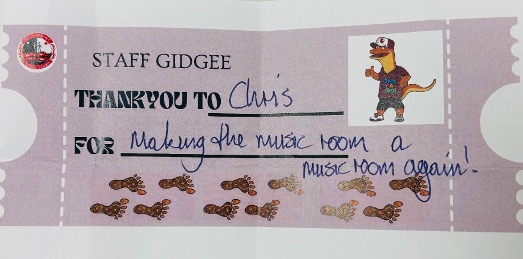
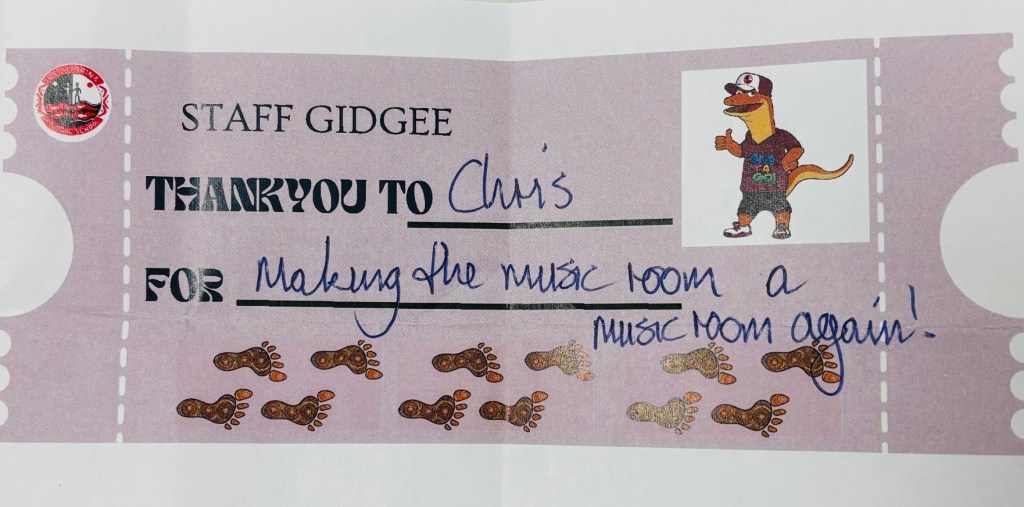
Since starting my temporary role as Assistant Principal at Brewarrina Central School, I’ve received several staff “gidgees” (the name comes from the school mascot, Gidgee the Goanna), which are an anonymous acknowledgment for a job well done, shared at the Monday staff meeting, accompanied by a chocolate. It’s always a nice surprise to receive a gidgee; I love the chocolate, and the acknowledgment in front of peers accompanied by the mystery of who wrote the gidgee are all part of the fun!
Final Thoughts
Creating a culture where staff feel valued, appreciated, and effectively communicated with can have a profound impact on their wellbeing and, consequently, on the overall performance of the school.
I’d love to hear your thoughts on what works in terms of improving staff wellbeing. What strategies have you found effective in your own experience? Let’s continue this important conversation and share our insights to foster healthier and happier workplaces for everyone.
Yours in education,
Chris English
References:
- Biddle, S. J., & Asare, M. (2011). Physical activity and mental health in children and adolescents: A review of reviews. British Journal of Sports Medicine, 45(11), 886-895.Clampitt, P. G., & Downs, C. W. (1993). Employee perceptions of the relationship between communication and productivity: A field study. Journal of Business Communication, 30(1), 5-28.
- Covey, S. R. (1989). The 7 habits of highly effective people: Powerful lessons in personal change. Free Press.
- Dunbar, R. I. (2017). Breaking bread: The functions of social eating. Adaptive Human Behavior and Physiology, 3(3), 198-211.
- Guskey, T. R. (2002). Professional development and teacher change. Teachers and Teaching: Theory and Practice, 8(3), 381-391.
- Oberle, E., & Schonert-Reichl, K. A. (2016). Stress contagion in the classroom? The link between classroom teacher burnout and morning cortisol in elementary school students. Social Science & Medicine, 159, 30-37.
- Sinek, S. (n.d.). [Quote on leadership and workplace wellbeing].
- Umlas, J. W. (2017). The power of acknowledgment. iUniverse.
- LBMC. (n.d.). Characteristics of a positive workplace culture. Retrieved July 16, 2024, from https://www.lbmc.com/blog/characteristics-positive-workplace-culture/

 Chris English
Great email Chris. A giant Giddgy from me. I always found Covey’s habits very useful. Pat B
LikeLike