
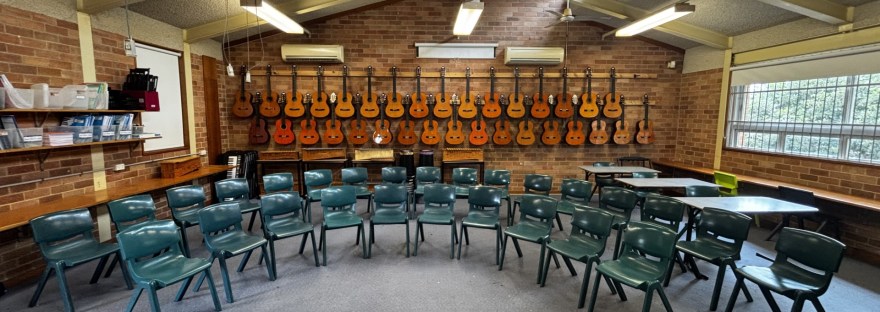
Music teacher happiness is a classroom without desks.
Seven weeks into my new role, I finally ripped the band aid off and removed the desks** from my music room.
For many years, desks had been a staple of the space. They were part of the traditional classroom setup and, understandably, part of the routine students were used to. Change like this always takes a little adjustment.
(**That said, the desks haven’t disappeared entirely. If needed, about 14 students can still be seated at permanent benches around the perimeter of the room (also used for keyboards), and I’ve kept 3 double desks for students who may at time require a more structured seating arrangement, noting I work at a very low socioeconomic public high school in NSW, Australia, catering to an extremely diverse range of learners.)
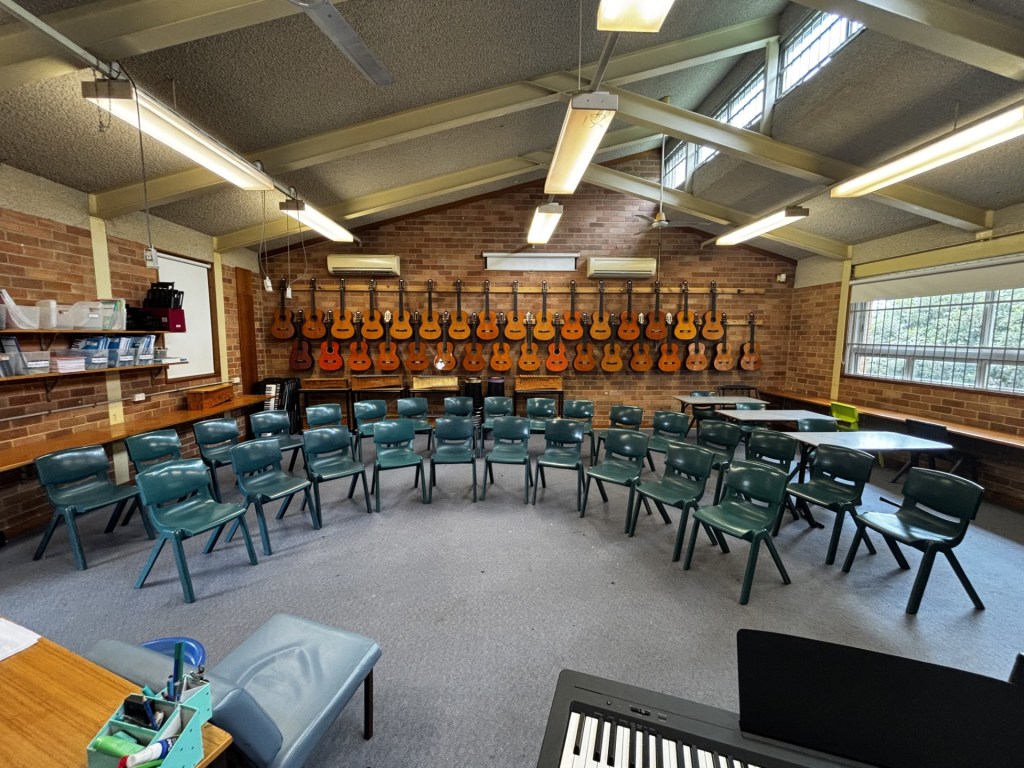
But the centre of the room is now open.
And that open space changes everything.
Making Music, Not Just Learning About It
Music education should be active, physical and collaborative. When desks dominate a room, the message students receive is subtle but powerful: sit still, write things down and listen.
While written work certainly has its place in music education, the heart of learning music lies in doing.
Removing the desks allows the classroom to become a space for:
- bucket drumming and rhythm ensembles
- tuned percussion and Orff instruments
- guitar and ukulele playing
- movement and body percussion
- collaborative music making
The room now invites students to pick up instruments, move, listen, respond and create together.
Learning Through Orff and Kodály
The change also reflects two pedagogical approaches that have strongly influenced my teaching: Orff Schulwerk and the Kodály Method.
Both approaches emphasise that music learning should be active, sequential and deeply connected to listening, singing and movement.
Composer and educator Carl Orff captured this beautifully when he wrote:
“Experience first, then intellectualise.”
In other words, students should make music first, and only afterwards analyse or notate what they have learned.
Designing the Room Around Music Making
When students walk into the room now, they immediately see guitars hanging on the wall, instruments ready to be played and chairs arranged for ensemble work. Bags are placed to the side of the room, and the seating arrangement intentionally means the student’s body language is open and no longer hiding behind desks.
Further to this, I find the desks create more issues than should supposedly solve. Desks mean students want their bags at their feet, and the orientation required to squeeze the desks in the room meant that many students weren’t naturally facing the front of the room. When the students weren’t fidgeting with the contents of their bag (usually their phones), they tend to swing the desks and cause further disruption. Not to mention the constant issue of chewing gum ending up underneath them!
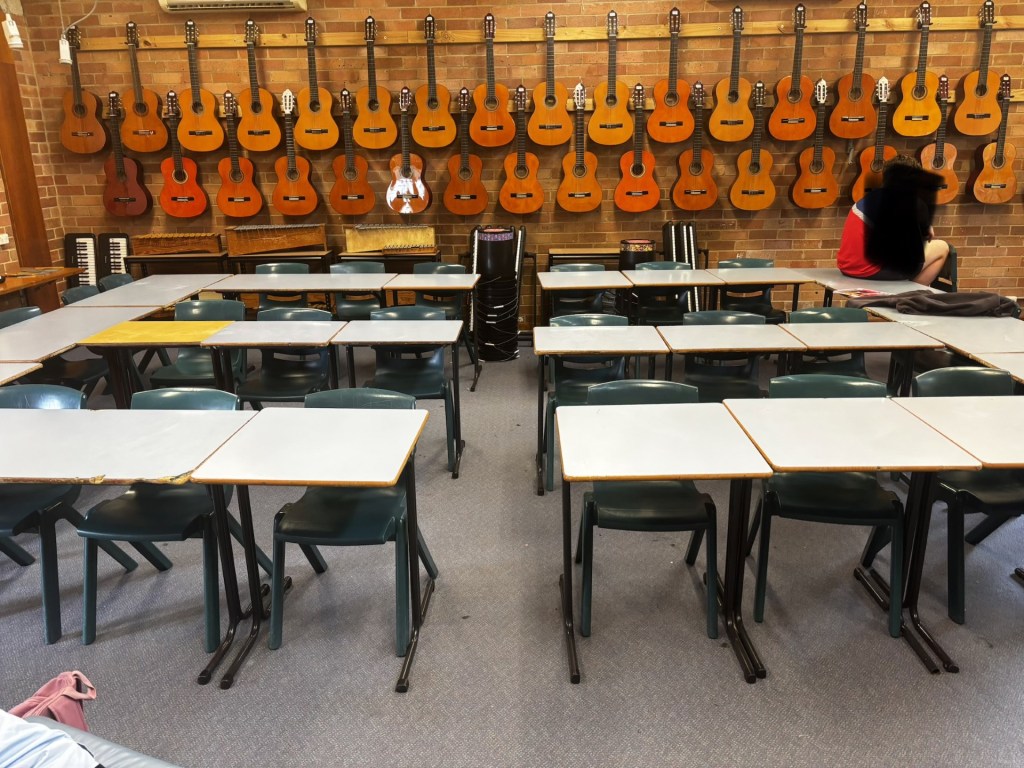
Now the space communicates something important:
This is a place where we make music.
Classroom environments shape behaviour and expectations. By removing desks from the centre of the room, the focus shifts naturally toward participation, listening and collaboration.
A Small Change With Big Impact
It might seem like a small decision, but the physical layout of a classroom has a powerful impact on learning.
By opening up the space, students have more freedom to move, play and engage with music in meaningful ways.
And for a music teacher, there is something deeply satisfying about seeing a room full of students actively making music together.
No desks required.

 Chris English